<?xml version="1.0" encoding="utf-8"?>
<feed xmlns="http://www.w3.org/2005/Atom">
	<title type="html"><![CDATA[Forex Software — end of week and trailing]]></title>
	<link rel="self" href="https://forexsb.com/forum/feed/atom/topic/8402/" />
	<updated>2020-05-25T08:49:08Z</updated>
	<generator>PunBB</generator>
	<id>https://forexsb.com/forum/topic/8402/end-of-week-and-trailing/</id>
		<entry>
			<title type="html"><![CDATA[Re: end of week and trailing]]></title>
			<link rel="alternate" href="https://forexsb.com/forum/post/60813/#p60813" />
			<content type="html"><![CDATA[<div class="quotebox"><cite>divarak wrote:</cite><blockquote><div class="quotebox"><cite>footon wrote:</cite><blockquote><p>Probably you didn&#039;t have a signal then. If you have weekend close + another conditions, then those conditions are evaluated at weekend close, just like you made it to do. It is important to understand the relation between closing point and closing condition slots.</p></blockquote></div><p>footon... Do I have a way to force to close operations no matter if they are profitable or not at the end of the week, and also use another indicator to close some positions?</p><p>If I put week closing 2, there is no way to close positions using another indicator. </p><p>Regards.<br />divarak</p></blockquote></div><p>Try this =&gt; <a href="https://forexsb.com/repository/repository_indicators/forex_indicator_review/143/day-of-week-exit">https://forexsb.com/repository/reposito … -week-exit</a></p>]]></content>
			<author>
				<name><![CDATA[footon]]></name>
				<uri>https://forexsb.com/forum/user/1242/</uri>
			</author>
			<updated>2020-05-25T08:49:08Z</updated>
			<id>https://forexsb.com/forum/post/60813/#p60813</id>
		</entry>
		<entry>
			<title type="html"><![CDATA[Re: end of week and trailing]]></title>
			<link rel="alternate" href="https://forexsb.com/forum/post/60807/#p60807" />
			<content type="html"><![CDATA[<div class="quotebox"><cite>divarak wrote:</cite><blockquote><p>ats118765, it is really interesting what you post about long term sucess strategies... In my case I am focused on short term strategies, I hope I can put into work your explanation.</p></blockquote></div><p>Hey divarak. If you are looking at short term strats you will need a different form of workflow method. The process I outlined was specific to diversified systematic trend following of a medium to long term duration.....</p><p>Cheers</p><p>Rich</p>]]></content>
			<author>
				<name><![CDATA[ats118765]]></name>
				<uri>https://forexsb.com/forum/user/10668/</uri>
			</author>
			<updated>2020-05-25T02:54:26Z</updated>
			<id>https://forexsb.com/forum/post/60807/#p60807</id>
		</entry>
		<entry>
			<title type="html"><![CDATA[Re: end of week and trailing]]></title>
			<link rel="alternate" href="https://forexsb.com/forum/post/60806/#p60806" />
			<content type="html"><![CDATA[<div class="quotebox"><cite>footon wrote:</cite><blockquote><p>Probably you didn&#039;t have a signal then. If you have weekend close + another conditions, then those conditions are evaluated at weekend close, just like you made it to do. It is important to understand the relation between closing point and closing condition slots.</p></blockquote></div><p>footon... Do I have a way to force to close operations no matter if they are profitable or not at the end of the week, and also use another indicator to close some positions?</p><p>If I put week closing 2, there is no way to close positions using another indicator. </p><p>Regards.<br />divarak</p>]]></content>
			<author>
				<name><![CDATA[divarak]]></name>
				<uri>https://forexsb.com/forum/user/8455/</uri>
			</author>
			<updated>2020-05-25T00:03:25Z</updated>
			<id>https://forexsb.com/forum/post/60806/#p60806</id>
		</entry>
		<entry>
			<title type="html"><![CDATA[Re: end of week and trailing]]></title>
			<link rel="alternate" href="https://forexsb.com/forum/post/60804/#p60804" />
			<content type="html"><![CDATA[<p>Probably you didn&#039;t have a signal then. If you have weekend close + another conditions, then those conditions are evaluated at weekend close, just like you made it to do. It is important to understand the relation between closing point and closing condition slots.</p>]]></content>
			<author>
				<name><![CDATA[footon]]></name>
				<uri>https://forexsb.com/forum/user/1242/</uri>
			</author>
			<updated>2020-05-24T22:50:34Z</updated>
			<id>https://forexsb.com/forum/post/60804/#p60804</id>
		</entry>
		<entry>
			<title type="html"><![CDATA[Re: end of week and trailing]]></title>
			<link rel="alternate" href="https://forexsb.com/forum/post/60803/#p60803" />
			<content type="html"><![CDATA[<p>Hello Everybody! Sorry not no show up before. Thank you all for the replies...</p><p>Yonkuro, how about use OOS in Generator/Optimizer? Should I get the same results? I also agree with Balaiserboy about the data horizon option.</p><p>ats118765, it is really interesting what you post about long term sucess strategies... In my case I am focused on short term strategies, I hope I can put into work your explanation.</p><p>Now I am getting another problem...</p><p>I used week closing on some strategies... But on the last day of the week, the positions still there, and now the next week started, the positions didn&#039;t close either...</p><p>I am doing something wrong? The week closing indicator isn&#039;t the only one in the exit slots.</p>]]></content>
			<author>
				<name><![CDATA[divarak]]></name>
				<uri>https://forexsb.com/forum/user/8455/</uri>
			</author>
			<updated>2020-05-24T21:30:36Z</updated>
			<id>https://forexsb.com/forum/post/60803/#p60803</id>
		</entry>
		<entry>
			<title type="html"><![CDATA[Re: end of week and trailing]]></title>
			<link rel="alternate" href="https://forexsb.com/forum/post/60786/#p60786" />
			<content type="html"><![CDATA[<div class="quotebox"><cite>footon wrote:</cite><blockquote><p>Ah, it is 85/15 this way, yes. Thank you, Rich, for taking time to explain. Your posts offer great value!</p></blockquote></div><p>Cheers footon :-)</p>]]></content>
			<author>
				<name><![CDATA[ats118765]]></name>
				<uri>https://forexsb.com/forum/user/10668/</uri>
			</author>
			<updated>2020-05-23T09:34:22Z</updated>
			<id>https://forexsb.com/forum/post/60786/#p60786</id>
		</entry>
		<entry>
			<title type="html"><![CDATA[Re: end of week and trailing]]></title>
			<link rel="alternate" href="https://forexsb.com/forum/post/60785/#p60785" />
			<content type="html"><![CDATA[<p>Ah, it is 85/15 this way, yes. Thank you, Rich, for taking time to explain. Your posts offer great value!</p>]]></content>
			<author>
				<name><![CDATA[footon]]></name>
				<uri>https://forexsb.com/forum/user/1242/</uri>
			</author>
			<updated>2020-05-23T08:52:19Z</updated>
			<id>https://forexsb.com/forum/post/60785/#p60785</id>
		</entry>
		<entry>
			<title type="html"><![CDATA[Re: end of week and trailing]]></title>
			<link rel="alternate" href="https://forexsb.com/forum/post/60784/#p60784" />
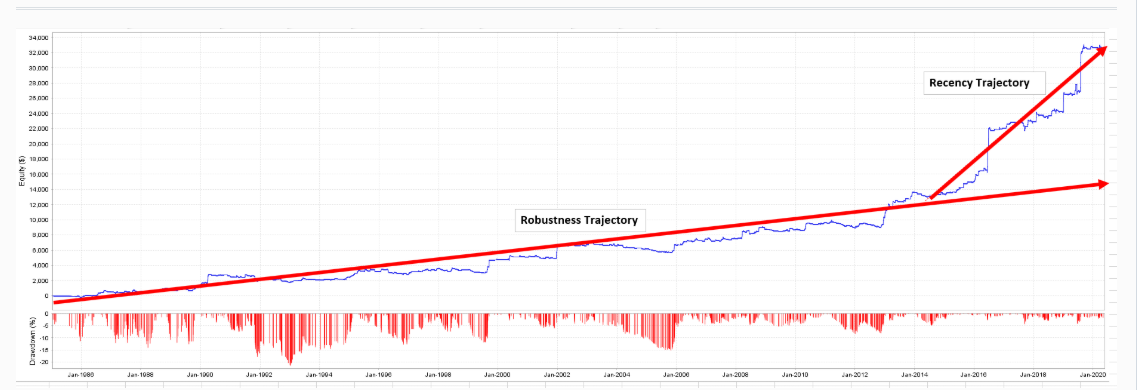
			<content type="html"><![CDATA[<p>In forward testing land for trend following systems....your worst drawdown is always ahead of you. In backtest land, the corollary is that your worst drawdown is always behind you.</p><p>The deterioration progressively deteriorates in time away from the period in which the design was created. So if your design was created using recent data...the deterioration occurs in the past away from this recent set of conditions in a backtest.....and in the more distant future with live trading.&nbsp; </p><p>Have a look at the drawdown profile of the chart posted in the prior post. You will see that the Drawdown increases as you go further back in time. This is principally due to the fact that the Ea&#039;s were mined with data between 2015 to 2020. A similar deterioration is likely to be expected&nbsp; going forward in time. It is not because &#039;they are necessarily broke&#039; but rather a natural consequence of signal deterioration over time with adaptive markets. You therefore need to establish &#039;bounds of tolerance&#039; in your projections going forward to establish whether the system is &#039;broke&#039; or simply &#039;less efficient&#039; than it used to be. Without hindsite it is very difficult determining which is which....so the worst case bound (your long term historic projection - robustness projection) is your benchmark.</p><p>What you tend to find is that the efficacy of your trend following model (signal strength) progressively deteriorates when subjected to noise and probably associated with the fact that markets evolve over time. Even trends are affected by the impacts of noise.</p><p>So you need a method to keep them sharp and &#039;contemporary&#039;. The trends of the 1980s and 1990s are different to the trends of today which are much more &#039;volatile&#039; in nature. So the models you create in the 1980s (eg. the Turtle strategy) needs to adapt to more recent trends to survive and prosper.</p><p>The core strategy itself (say the entry and exit of the Turtles strategy) can &#039;almost&#039; be defined in EA studio using entry presets etc. etc. etc and you can then data mine around this core trend following strategy to generate a diverse array of &#039;contemporary variables such as the lookback length, volatility range etc.&#039;. The data mining process is used to &#039;sharpen&#039; the core model to reflect more recent conditions. Unfortunately you need to work within the limitations of the software so there are some features in EA studio that are lacking for the trend followers out there...such as volatility based stops and trails....but there are work around&#039;s which can almost achieve the desired result.</p>]]></content>
			<author>
				<name><![CDATA[ats118765]]></name>
				<uri>https://forexsb.com/forum/user/10668/</uri>
			</author>
			<updated>2020-05-23T02:25:57Z</updated>
			<id>https://forexsb.com/forum/post/60784/#p60784</id>
		</entry>
		<entry>
			<title type="html"><![CDATA[Re: end of week and trailing]]></title>
			<link rel="alternate" href="https://forexsb.com/forum/post/60783/#p60783" />
			<content type="html"><![CDATA[<div class="quotebox"><cite>footon wrote:</cite><blockquote><div class="quotebox"><cite>ats118765 wrote:</cite><blockquote><p> Approximately 85% of the data in this phase will be OOS. </p><p>Rich</p></blockquote></div><p>You mean 85 IS and 15 OOS?</p><p>Why don&#039;t you look OOS data separately? Why do you add the last 15% data for overall check-up? It is already established that all of those, which get tested in the 2nd phase, are &quot;winners&quot;, so it only makes sense to check whether they are winners on the OOS part. Are you trying to say that 15% of data is too short for really assessing the trend-following edge? It is an interesting idea, hope you can explain it a bit more, usually OOS is looked separately.</p></blockquote></div><p>The entire data range for the example is 1985.01.01 to say 2020.04.30</p><p>Phase 1) The data in which the EA is created in the reactor is say 2015.04.01 - 2020.04.30 = The dated range represents the In Sample part of the entire date range. (In sample&nbsp; = 15% of total data range). This is where the collections are created and honed for recent market conditions. This is also where it is possible to &#039;curve fit&#039; the result.</p><p>Phase 2) The remaining data is used for validation only = 1985.01.01 - 2015.03.31 = OOS (85%). This is where the phase 1) collection is filtered to include only those survivors from Phase 1) that also exhibit robustness.</p><p>The result of both phases is a collection of :<br />1) Recent performers; AND<br />2) Survivors.</p><p>You validate across the entire data sample to generate an equity curve that gives both &#039;robust phases and &#039;recency phases&#039; and plot regressions across the components to give &#039;future performance bounds&#039; within which you oversee performance. </p><p><span class="postimg"><img src="https://atstradingsolutions.com/wp-content/uploads/2020/05/Equity-Curve.png" alt="https://atstradingsolutions.com/wp-content/uploads/2020/05/Equity-Curve.png" /></span></p><p>If future performance falls below the &#039;robustness projection&#039;, you replace the EA.</p><p>I find that there is inevitably a drop in performance when you take data mined EAs into the battlefield. This is understandable and to be expected however as future conditions are always slightly different from those market conditions in which the EAs were created. The problem however is that we just don&#039;t know whether the EAs are in a natural drawdown or are victims of curve fitting and have no enduring substance. This method plots logical bounds within which you manage the performance of your EAs.</p><p>Note: This process is only suggested for trend following models. Other methods require different robusness tools such as Monte Carlo and Walk Forward etc. </p><p>You only need a small in sample component to test whether your model is a trender or not. Most of the work is through the design process (eg. entry presets) plus stop and trailing stops. The data mining component (15%) is simply used to detect suitable parameters for the overall design that reflect &#039;more current market conditions&#039; and are diversified options with a weak edge. The bulk of your test needs to be OOS (eg. 85%) to see how that solution stacks up over &#039;unfavourable&#039; market conditions. This is to provide a degree of capital protection to your models.</p><p>How you then compile your diversified collection that have passed these tests is essential and where you need a compiler to examine correlations between the return streams.</p>]]></content>
			<author>
				<name><![CDATA[ats118765]]></name>
				<uri>https://forexsb.com/forum/user/10668/</uri>
			</author>
			<updated>2020-05-23T02:00:47Z</updated>
			<id>https://forexsb.com/forum/post/60783/#p60783</id>
		</entry>
		<entry>
			<title type="html"><![CDATA[Re: end of week and trailing]]></title>
			<link rel="alternate" href="https://forexsb.com/forum/post/60780/#p60780" />
			<content type="html"><![CDATA[<div class="quotebox"><cite>ats118765 wrote:</cite><blockquote><p> Approximately 85% of the data in this phase will be OOS. </p><p>Rich</p></blockquote></div><p>You mean 85 IS and 15 OOS?</p><p>Why don&#039;t you look OOS data separately? Why do you add the last 15% data for overall check-up? It is already established that all of those, which get tested in the 2nd phase, are &quot;winners&quot;, so it only makes sense to check whether they are winners on the OOS part. Are you trying to say that 15% of data is too short for really assessing the trend-following edge? It is an interesting idea, hope you can explain it a bit more, usually OOS is looked separately.</p>]]></content>
			<author>
				<name><![CDATA[footon]]></name>
				<uri>https://forexsb.com/forum/user/1242/</uri>
			</author>
			<updated>2020-05-22T18:20:30Z</updated>
			<id>https://forexsb.com/forum/post/60780/#p60780</id>
		</entry>
		<entry>
			<title type="html"><![CDATA[Re: end of week and trailing]]></title>
			<link rel="alternate" href="https://forexsb.com/forum/post/60779/#p60779" />
			<content type="html"><![CDATA[<div class="quotebox"><cite>hannahis wrote:</cite><blockquote><p>Retain these collections and rerun using the validator next month using a rolling 5 year window) but retain all the history for the robustness phase (this should just keep growing)...but the rolling 5 year window ensures your EA&#039;s keep fairly sharp. Continue to add to your base collections as well so that you continuously grow your collections.</p><br /><p>Excellent post!</p><p>I was about to ask you have you ensure the &quot;recency&quot; of your EA and I guess at every 6mth intervals, you use your same EA collection and re-run the lastest 5years data via Validator? (did I get it right?)</p><p>Cheers</p><p>Hannah</p></blockquote></div><p>You got it Hannah...but use whatever re-balance period you like. It might be worth doing the 5 year window on a monthly basis if you feel that is necessary. It keeps you occupied at least . :-)</p>]]></content>
			<author>
				<name><![CDATA[ats118765]]></name>
				<uri>https://forexsb.com/forum/user/10668/</uri>
			</author>
			<updated>2020-05-22T16:36:41Z</updated>
			<id>https://forexsb.com/forum/post/60779/#p60779</id>
		</entry>
		<entry>
			<title type="html"><![CDATA[Re: end of week and trailing]]></title>
			<link rel="alternate" href="https://forexsb.com/forum/post/60778/#p60778" />
			<content type="html"><![CDATA[<div class="quotebox"><cite>Blaiserboy wrote:</cite><blockquote><p>Thanks for taking the time for all of these details</p><p>I am seeing now why I should have studied more math back in the day.</p><p>Attempting to do automated trading without math skills is almost impossible.</p><p>I will start to work on this later in the day.</p><p>I really appreciate your efforts</p><p>Thanks again.</p><p>daveM</p></blockquote></div><p>Cheers Dave. I totally understand mate. </p><p>These data mining techniques are stunning &#039;Programming works of master craftsmen&#039; and you can really quickly lose your way....but in the end I personally feel that you really need to step back and then get under the hood to examine each step of the process to identify if it adds or detracts to the value of the outcome.</p>]]></content>
			<author>
				<name><![CDATA[ats118765]]></name>
				<uri>https://forexsb.com/forum/user/10668/</uri>
			</author>
			<updated>2020-05-22T16:32:55Z</updated>
			<id>https://forexsb.com/forum/post/60778/#p60778</id>
		</entry>
		<entry>
			<title type="html"><![CDATA[Re: end of week and trailing]]></title>
			<link rel="alternate" href="https://forexsb.com/forum/post/60777/#p60777" />
			<content type="html"><![CDATA[<p>Retain these collections and rerun using the validator next month using a rolling 5 year window) but retain all the history for the robustness phase (this should just keep growing)...but the rolling 5 year window ensures your EA&#039;s keep fairly sharp. Continue to add to your base collections as well so that you continuously grow your collections.</p><br /><p>Excellent post!</p><p>I was about to ask you have you ensure the &quot;recency&quot; of your EA and I guess at every 6mth intervals, you use your same EA collection and re-run the lastest 5years data via Validator? (did I get it right?)</p><p>Cheers</p><p>Hannah</p>]]></content>
			<author>
				<name><![CDATA[hannahis]]></name>
				<uri>https://forexsb.com/forum/user/2809/</uri>
			</author>
			<updated>2020-05-22T16:30:53Z</updated>
			<id>https://forexsb.com/forum/post/60777/#p60777</id>
		</entry>
		<entry>
			<title type="html"><![CDATA[Re: end of week and trailing]]></title>
			<link rel="alternate" href="https://forexsb.com/forum/post/60776/#p60776" />
			<content type="html"><![CDATA[<p>Thanks for taking the time for all of these details</p><p>I am seeing now why I should have studied more math back in the day.</p><p>Attempting to do automated trading without math skills is almost impossible.</p><p>I will start to work on this later in the day.</p><p>I really appreciate your efforts</p><p>Thanks again.</p><p>daveM</p>]]></content>
			<author>
				<name><![CDATA[Blaiserboy]]></name>
				<uri>https://forexsb.com/forum/user/2491/</uri>
			</author>
			<updated>2020-05-22T16:22:33Z</updated>
			<id>https://forexsb.com/forum/post/60776/#p60776</id>
		</entry>
		<entry>
			<title type="html"><![CDATA[Re: end of week and trailing]]></title>
			<link rel="alternate" href="https://forexsb.com/forum/post/60775/#p60775" />
			<content type="html"><![CDATA[<div class="quotebox"><cite>Blaiserboy wrote:</cite><blockquote><p>Rich.....</p><p>Would it be possible for you to illustrate some settings re the&nbsp; 85/15.</p><p>I think I am grasping your approach but I am lost as to how you execute the plan.</p><p>Would you be able to clarify a bit</p><p>Thanks very much</p><p>daveM</p></blockquote></div><p>Hi Dave</p><p>I do this stuff mostly within MT4....but I was thinking that a way to apply it for EA Studio would be as follows.</p><p>If you wanted to do this exercise within EA studio&nbsp; using the validation tool, you would need to upload your entire data history into EA Studio. I think we can have up to 500,000&nbsp; bars in EA Studio (not sure).</p><p>Undertake your workflow process to data mine using the data horizon for say the last 5 years (up to&nbsp; say last month) using D1 data for your trend following model. The reason why I suggest a trend following model is that it is very unlikely that other methods will stack up over such large data sets.</p><p>Rather than optimise these strategies, simply generate lots of different &#039;entry&#039; types of trend following models using your presets where possible and use initial stop and trailing stop only for exits. Diversification is what you are looking for.</p><p>This will generate a collection per market of say 100 solutions that have been data mined over the 5 year range (no OOS). Save this set and then create another set on another market. Let&#039;s say we get a collection of 10 different markets with say 100 solutions each. Assume we use validation criteria that sets the bar fairly high for this short term testing.</p><p>Now that you have your sets of 100 x 10 markets..save these collections and name them and then re-import into the validator but then retest the entire set of collections on very long range data also up to last month. Approximately 85% of the data in this phase will be OOS. Set the validation criteria a bit lower but ensure that your criteria demonstrate positive expectancy and good return/drawdown.</p><p>Save the successful candidates from the run. You may find you need to redo the entire workflow to this point a few times until you build a sufficient stock pile of collections that have passed both the short range and the long range test period.</p><p>Let&#039;s say you create a stockpile of say 100 solutions per market that are both:<br />1) Short term solid performers - This ensures that your solutions are &#039;recent&#039; strong performers; and also<br />2) Robust candidates long term (that won&#039;t fall over as soon as you implement them live). This preserves your capital.</p><p>Then re-import back into the validator and use the short term settings again and rank your validated results from top to bottom using your preferred metric. I would probably use return to drawdown again.</p><p>You will then need to compile say the top xx of them into a preferred sub portfolio (per market) using portfolio compiler software (say QuantAnalyzer) to get the best bang for buck in terms of correlation.....and then further compile these sub portfolios into multi-market solutions that offer &#039;the best bang for buck&#039; in terms of correlation.</p><p>Put onto a demo (only for a short period to confirm it is free of execution issues) and deploy as soon as you can.</p><p>Retain these collections and rerun using the validator next month using a rolling 5 year window) but retain all the history for the robustness phase (this should just keep growing)...but the rolling 5 year window ensures your EA&#039;s keep fairly sharp. Continue to add to your base collections as well so that you continuously grow your collections.</p><p>This process would only be advised for trend following models where Monte Carlo and Walk forward testing methods are not recommended.</p><p>Something like this Dave. I hope it makes sense :-)</p><p>Cheers</p><p>Rich</p>]]></content>
			<author>
				<name><![CDATA[ats118765]]></name>
				<uri>https://forexsb.com/forum/user/10668/</uri>
			</author>
			<updated>2020-05-22T16:09:04Z</updated>
			<id>https://forexsb.com/forum/post/60775/#p60775</id>
		</entry>
</feed>